Monday, January 31, 2011

Who's Fining Who?

El Periodico has a rundown of the 45 sanctions that have been levelled against political parties in recent months. The fines are for between US$100 and US$125. Here we go.
Partido Patriota (8)
Libertad Democrática Renovada (7)
Partido Unionista (6)
Vision con Valores (4)
Accion de Dessarrollo Nacional (3)
Frente Republicano Guatemalteco  (1)
Gran Alianza Nacional (3)
Encuentro por Guatemala (1)
Movimiento Integral de Oportunidades "Pais" (MIO) (1)
Victoria (3)
Unidad Nacional de la Esperanza (3)
Compromiso, Renovacion y Orden (Creo) (2)
Partido de Avanzada Nacional  (1)

Two mayors have also been fined - José Antonio Coro (Santa Catarina Pinula) and Flavio José Jojcom (San Juan la Laguna, Sololá).

Out of all the parties listed above, Otto Perez and the PP probably need the least publicity. Perez finished second in 2007. He has strong name recognition. The PP now has the second largest number of seats in the congress (30). More people feel a connection with the PP than any other party. Yet, there they are plastered throughout the entire country and suffering through those US$100 fines.

Sunday, January 30, 2011

Guatemalan Left Seeks a Broad Front

Representatives from the Guatemalan left met in Zona 2 of the capital on Saturday to discuss the possibility of creating a broad front to contest September's elections. Party leaders from the URNG and the ANN met with representatives from the country's social organizations, unions, and peasant and environmental groups.  In addition to the URNG and the ANN, a broad front might include Winaq (Rigoberta Menchu's party) and the Encuentro por Guatemala (Nineth Montenegro's party).

It's possible that the left can form a broad front to compete in the upcoming elections. They tried in 1999, 2003, and 2007 to varying degrees of failure.I can't say that there's much hope for them in this year's presidential elections, but they could pick up a few diputados and alcaldes so that the media might actually begin to cover their activities. As of today, the ANN, URNG, and EG maintain 3 seats (out of 158) in the congress - two for the URNG and one for the EG.

Economic Pessimism in Guatemala

According to a survey carried out by Latinbarometer, Guatemalans are more pessimistic about their economic future than any other country of Latin America. Some 62% fear remaining unemployed this year.

In 2009 and 2010, the country's GDP grew at rates of 0.5% and 2.6%, less than what is needed to improved the livelihoods of the 51% of the country that lives in poverty. As a result of the slow economic growth, analysts are predicting that both the Costa Rican and Panamanian economies will surpass that of Guatemala within the next 50 years.

Friday, January 28, 2011

Obama's heading to El Salvador

As everyone has heard by now, President Obama announced that he will be traveling to El Salvador in March. There appears to be some confusion, however, as to what will be on the agenda - immigration, organized crime, drug trafficking, etc. From my perspective, it doesn't really matter. The significance is that he is going.

US President Barack Obama is going to with his counterpart President Mauricio Funes of El Salvador and representative of the governing FMLN party. After a decade of working to prevent the FMLN from coming to power via revolution and another seventeen years of trying to prevent it from coming to power through elections, Obama is now going to El Salvador to meet with Funes and other FMLN leaders in El Salvador(how can he not?).

This is a momentous occasion in post-Cold War US-LA and US-ES relations. Some observers have been disappointment with the Obama administration's stance towards Latin America during the first two years of his administration and have found little differences between his and his predecessor's approach. But does anyone think that this would have happened with a Republican or most other Democrats in the presidency?

It's such an important moment that I really hope that other Central American leaders are not invited. Who wants to hear whether Ortega gets a cold and cancels at the last minute or whether the Guatemalan First Lady is told to stay home so that her appearance is not used in a campaign photo. Let the US and El Salvador, a country that has come to be one of our most important allies in Central America, share the spotlight.

The US and ARENA had a good working relationship and I hope that the US and the FMLN can continue that relationship (Our Enduring Relationship). Even if Obama and Funes do talk immigration, crime, and drug trafficking, I don't think that they'll able to announce anything significant. That's why I'd love to hear some announcement about an agreement on health care (near and dear to both our hearts), education (probably not as he obviously have to meet with Sanchez Ceren), or maybe the environment (renewable energy related perhaps? can't seem him meeting with anyone about gold mining as we wouldn't want to upset our northern neighbors).

Now we need to give him some advice about where to go. While I'd love to have him go here (I am a bit partial), here are the three stops he should make.
    Romero's tomb in the Cathedral (it is March).

The Wall of Memory and Truth in Parque Cuscatlan

From what I remember, there's a plaque with the names of US service members killed in
El Salvador located on the Embassy's grounds
Credit: Rick Steves
These are places to go and pay respects. What's your take? Got better ones?

Thursday, January 27, 2011

What's Your Favorite Party?

Vox Latina recently carried out a nationwide survey in Guatemala between January 5 and 11. To no one's surprise, the nation's political parties did not come out looking too good.

Guatemalans were asked whether they sympathized with any political party or whether one was most convincing to them this campaign.
49% of the respondents answered none. Otto Perez Molina's PP came in second with 22.4%. While Vox Latina warns that one should not infer from these numbers how Guatemalans are likely to vote in September, I can't imagine that UNE is feeling good right now.
As some of the analysts cited in the article make clear, the lack of identification with political parties is nothing new in Guatemala. Dinorah Azpuru argues that parties do not look to promote participation in the political process beyond elections and that, in return, citizens show little interest in parties.
While it will be strange for the first and second place finishers from the 2007 election to finish first and second in 2011 (typically the governing party suffers dramatic losses and primary opposition party emerges victorious in the next election), it's not because Guatemalans have come to identify with either party and that we are witnessing the creation of a two-party system. At least, not yet.
Finally, the percentages only add up to 98.2%. I am thinking that the ADN, ANN, EG, MIO, UD, BG and another three political parties have the other 1.8% support. That still leaves three political parties missing. Anybody have the names of the remaining three?

Elections News in Guatemala

A few notes on the 2011 elections

The TSE recently fined three political parties $125 each for violating campaign rules - the Patriotic Party, CREO, the PAN. A fourth political party, Victoria, was admonished for distributing flyers but since it was its first offense, the fine was waived. The PP, CREO, Victoria, and PAN now join UNE, Unionista, GANA, FRG, Lider, and EG, each of which was fined earlier this year or late last year. There are still thirteen parties to go before the TSE has fined everyone. Let's get a move on.

That's 45 sanctions so far. We're probably going to see an increase in the number of fines as campaigning really seems to have picked up in recent days and congress has been unwilling to increase the maximum penalty that the TSE can levy. Working against more sanctions, however, is the fact that the TSE just doesn't have enough personnel to oversee each of the twenty-five political parties.

Manuel Villacorta foresees a violent campaign season in an interview Prensa Libre and fears that the campaign will only serve to further discredit the political system. As most do, he sees UNE and PP as the two strongest parties heading into the September 4. What was interesting is that he believes that the PP might have made some inroads in the rural vote compared to 2007 that might make a difference in 2011.

While it's not certain that Sandra Torres will be the UNE candidate, three of her allies were just selected to lead the party heading into this year's elections. While most parties have accepted September 11 as the day of the vote, UNE is still unhappy. According to UNE representatives, they do not believe that it is appropriate to hold the election in Guatemala on a day when so many people died in New York. Others believe that UNE doesn't want anyone to make fun of the Colom sisters (Sandra and Gloria), portraying them as two burning towers, during their campaign.

Recently Colom and civil society have warned about organized crime infiltrating the electoral process. Barring any radical changes in the next two weeks, the country's political parties will sign an ethics pact on February 7 to try to address these concerns. The pact will add some transparency to how campaigns are financed by requiring each party to submit a monthly list of the names of their donors and their financial contributions. They will provide this information to the TSE. I can't remember where I read it, but there seemed to be some concern that this won't do much for municipal elections where the influence of organized crime is of the greatest concern.

Wednesday, January 26, 2011

Missouri Court Rules in Favor of Guatemalan Mother

The Missouri Supreme Court has sided with a Guatemalan immigrant in a child custody case, ruling the state failed to follow its laws in terminating her parental rights and allowing her son to be adopted by someone else.
But Tuesday’s decision does not automatically return the child to the mother. Instead, the court ordered the state to follow proper procedures and hold a new trial on whether the mother’s parental rights should be terminated. (Kansas City Star)
Encarnacion Bail Romero was arrested during an immigration raid in May 2007 at a chicken plant in Barry County, Missouri. Romero's family in the US ended up taking care of her son while she served a two-year prison sentence for using forged documents. At some point, the family could no longer care for the baby and the baby boy was adopted by the Mosers, a Missouri family. Romero said that she was okay with her son staying with the family temporarily, but that she did not agree to his adoption.

The seven-judge panel agreed that Romero's parental rights should not have been terminated by the state. However, they were divided over whether Romero should have been given immediate custody of the child. According to one of the judges,
"Every member of this Court agrees that this case is a travesty in its egregious procedural errors, its long duration, and its impact on Mother, Adoptive Parents, and, most importantly, Child.
The dissenting members of this Court rely significantly on information outside the record to find that Mother has been victimized repeatedly and that her rights have been violated. The dissenting members believe passionately that custody of Child should be returned to Mother without further proceedings. That result can be reached only by disregarding the law."
Unfortunately, for all involved, the case will again have to be heard by a trial court.

Tuesday, January 25, 2011

Murders up in Guatemala

Prensa Libre
On Sunday, I noted the perceived violent start to the year in Guatemala. Unfortunately, Prensa Libre presented some statistics today to back up that inital perception. Guatemalan officials report that 393 homicides occurred during the first three months of the year (January 1-23). During the entire month of January 2010, 365 murders were carried out.

Carlos Menocal, the Interior Minister, agreed that there have been more murders so far this year than last January but that the government is working to counter the violence.

According to Édgar Guerra, the President of the Association of Urban and Rural Transport Users, while the police have cracked down on crimes against urban buses, criminals have turned their attention towards more rural routes, attacking passengers and committing other violations.

I hoped that last year's decline in the murder rate was the beginning of a long-term downward trend. I had no evidence of that, just hope, and actually thought that there would be a surge in violence because of the potential extension of states of siege to other departments and the upcoming elections.

For UNE to maintain the presidency, it will have to show some tangible improvements in public security or at least make it look like the party has a plan and is implementing it.

Monday, January 24, 2011

Berenson to Remain Free

AP
On Monday, a Peruvian appeals court rejected the prosecutor's attempt to revoke Lori Berenson's parole. Berenson had been released in May but the prosecution had been trying to have her returned to jail because he did not believe that, as a convicted terrorist, Berenson should have been able to apply work and study credits towards the completion of her sentence.

Berenson says that she wants to return to NY to raise her son Salvador. However, she will have to remain in Peru until 2015 unless President Garcia commutes the rest of her sentence. I didn't think that it was wise of her to open up to reporters upon her release from prison earlier this year. Nothing good would come of criticizing the prosecution while her case was being appealed. I still don't think that it was smart but fortunately, for Berenson, the appeals court ruled in her favor.

Presidential elections are scheduled to take place in April so we probably won't have to wait too long to hear from the outgoing president, Alan Garcia.

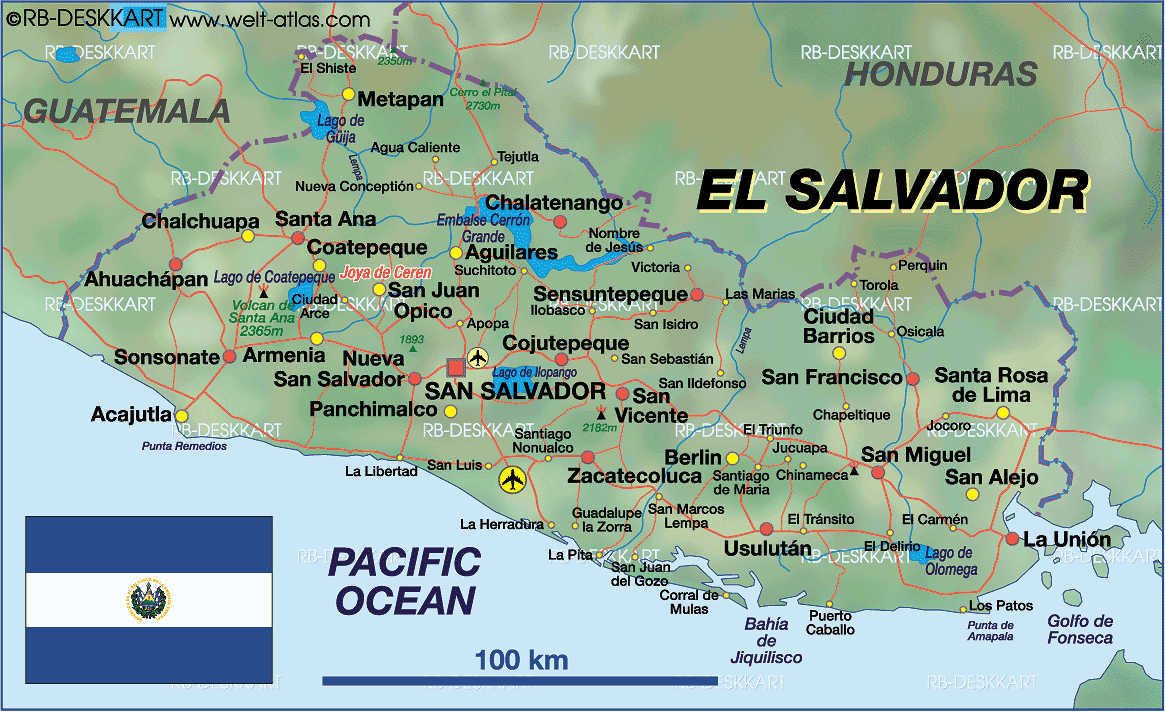
Bloody weekend, better month in El Salvador

El Salvador also suffered though its most violent day of the year this weekend. The PNC reports that there were twenty-one murders on Sunday. Sunday surpasses back-to-back violence of January 7 and 8 when seventeen people were killed each day (Contra Punto).

Seven murders occurred in San Salvador, four in Santa Ana, three in both Usulután y La Libertad, two in Sonsonate and one in La Unión.

However, murders are down compared to last year. During the first twenty-three days of 2010, three hundred and two people were murdered whereas "only" two hundred and sixty-seven have been murdered so far this year.

Sunday, January 23, 2011

Violent Start to Year in Guatemala

La Hora
While January is not yet complete, it is shaping up to be a pretty violent one in Guatemala. On Sunday, three young men were shot and killed and five others were seriously injured during a funeral service in a Protestant Church on the outskirts of Guatemala City. The funeral service was for a young man who had been murdered on Friday. Police are blaming the killings on youth gangs.

On Saturday night, one person was killed and another four injured during a shootout at a disco in Zona 1 of the capital. And in a particularly bloody day, twenty-three people were murdered on Friday. Six of the victims were women and one was five months pregnant.

On Thursday night, four people were killed (including a ten-year old boy) and another fourteen wounded during an attack targeting youths playing basketball or soccer in the Guatemalan capital. Like the Sunday killings, police are speculating that the motive for the shooting may have been score-settling between gangs.

In a survey earlier this month, seventy-eight percent of the respondents reported that violence and insecurity were the main problems facing the country. Last week's events are not going to change that.

Portillo Trial Begins

Former President Alfonso Portillo is currently on trial in Guatemala on embezzlement charges. He is accused of having stolen approximately $15-16 million dollars from the Defense Ministry in 2001. Portillo was president from 2000-2004. Two others former ministers are also on trial - former Defense Minister Eduardo Arevalo and former Finance Minister Manuel Maza.

CICIG and the US and French governments have provided some evidence against Portillo, including information on how money was transferred abroad in bank accounts registered to different family members. The trial was originally scheduled to begin in September, but defense lawyers have thrown up legal roadblocks along the way.

The trial is scheduled to last one month, but even Friday's opening got off to a rocky start. It was delayed a few hours while defense lawyers protested the presence of several CICIG bodyguards. They claimed that Portillo and his lawyers were intimidated by their presence. Prosecutors, on the other hand, were arguing that Arevalo and Maza should not have been been released and put under house arrest. They were flight risks as evidence by their previous flight from justice. They were also concerned that several of the fourteen witnesses have already been threatened. (BBC, Siglo XXI, El Periodico).

Portillo will be the first former president to stand trial in Guatemala, so it is an important test of the CICIG-improved justice system.  Hopefully, the trial will not prove as much of an embarrassment as the recent acquittal in Mexico of a man who bragged about killing his girlfriend.

Whatever the outcome, Portillo will probably have to stand trial in the US and/or France at some point as well.

Saturday, January 22, 2011

Salvadoran Cuisine in New York

In case you're traveling through Queens, New York and need some traditional Salvadoran cuisine, stop in at La Joya de Ceren in my hometown, Rockaway Park. The restaurant looks to have a pretty extensive menu and be reasonably priced.

Nothing has ever survived in the location that they have so they are going to need your help. Hopefully, they'll be selling Gallo when I am there for the town's St. Patrick's Day parade.

Friday, January 21, 2011

Argentine Forensic Anthropology Team

The Economist recently published an interview with Mercedes Doretti, the co-founder of the Argentine Forensic Anthropology Team.


See here for an earlier post or check out their website.

Thursday, January 20, 2011

Guatemala News

Some unconnected news:

In a recent interview with Prensa Libre, President Alvaro Colom said that his wife "Sandra could be a candidate" for president in this year's election.  You can find the transcript here.

The TSE also announced that the election will most likely be held on September 11th. A runoff will be held November 4th if no candidate captures 50 percent in the first round.

President Colom has extended the state of siege in Alta Verapaz for another 30 days (Prensa Libre, El PeriodicoAP). Polls indicate that most Guatemalans support the state of siege. Activists and members of nongovernmental organizations were skeptical about the initial state of siege and remain so about its extension.

The government claims that 41people were arrested in the first month of the siege and crime has fallen approximately 30 or 45 percent (what's the difference, right?) in the region. According to the Interior Minister's office, of the 41 arrested, 18 are Zetas.

You'll have to take their word for it, however, because the prosecutor's office has only seen evidence confirming that 2 are Zetas.

Another Dos Erres Murderer Arrested

Jorge Vinicio Orantes Sosa, a dual citizen of the United States and Canada was arrested on Wednesday in Calgary. Sosa is alleged to have been one of the military leaders involved in the Dos Erres massacre in 1982 at the height of the genocide in Guatemala. During the attack, over two hundred and fifty men, women and children were massacred.

Sosa's family says that he brought them to Mexico in the mid-1980s and then on to Canada in 1988 in order to escape violence and corruption in Guatemala, where he had served in the military (CTV.CA, has the story and a short video of his capture 1 minute in). After arriving in Canada, Sosa operated martial arts training schools in Calgary and Lethbridge and travelled the world competing. At some point in the 1990s, he relocated to the United States. After U.S. officials searched his home in Riverside County, California last spring, he fled to Mexico.

In one story, Sosa has apparently been open with his family in telling them that he was at Dos Erres when the massacre took place but he denied to them that he had participated in any way (The Toronto Sun). In another story, however, "While Sosa's army past is not a family secret, they say Sosa sought political asylum when he arrived in the United States in the mid-1980s. He told authorities of his past, they say." (Calgary Herald).
 When Sosa left Guatemala in the mid 1980s and arrived in the U.S. with a young family, he sought political asylum, his son said.

"He told the U.S. government everything. There are no secrets. He wanted to be free and live in happiness and in the American way," he said.

"I honestly don't think he would do that (make a false statement). What's the point of lying if you've asked for political asylum?" (The Province)
Unless Sosa told authorities that he feared for his life because he did not take part in the massacre, that doesn't make sense. If he told them that he took part in the massacre but now fears for his life, that's not really strong grounds for asylum.

The United States has asked the Canadian government to extradite Sosa so that he can face charges of lying on his US citizenship application. The case is drawing similarities to that of Gilberto Jordan (see here and here). Jordan also participated in the attack on Dos Erres, having admitted to killing a baby by throwing it down a well. He was sentenced to ten years in prison for concealing his part in the bloodshed when he applied for US citizenship. Zero-six months in prison and then deportation is the typical sentence for lying on one's application. However, Jordan got the max because his lie was so egregious. Jordan will in all likelihood be deported to Guatemala upon completion of his sentence. Sosa's case is a bit different because he holds dual US-Canadian citizenship.

Those close to Sosa are laying the groundwork for his defense - at least in terms of where he should stand trial. They do not want him extradited to Guatemala because he will in all likelihood be executed if found guilty. It's possible, but Guatemala doesn't have a very active death penalty. President Colom vetoed legislation in November that would have reinstated the death penalty (see here). Should UNE win the upcoming presidential elections (with Sandra Torres the most likely candidate), I don't see a change in the death penalty. Should Otto Perez Molina and the Patriotic Party win the upcoming presidential election, a change in the use of the death penalty is much more likely. However, it's difficult to see an administration headed by General Molina apply the death penalty against a former kaibil.

They also don't want him extradited to the US. At least to me, it seems a tough sell to fight Sosa's extradition to the United States to answer charges for having lied on his citizenship application based on the fear that if he is convicted and serves his sentence in the US, he will then be deported to Guatemala to face trial for war crimes. First, while thousands of soldiers, police, paramilitary, and government officials were involved in human rights abuses (including rape, torture, murder, etc.) during the conflict, there's only a dozen or so that have faced or are facing charges. Second, Sosa is a dual US-Canadian citizen. Unless Canada also revokes his citizenship, wouldn't he then be deported from the US back to Canada after having served time?

The Canadian government and courts will have to decide what to do with Sosa first. Do they try to revoke his citizenship for most likely lying on his application as well? Or do they try him for war crimes in a Canadian court?

Wednesday, January 19, 2011

Former Congressman Assassinated in Guatemala

A former member of Congress from the Patriotic Party was murdered on Wednesday inside a shopping mall in the western part of Guatemala City (Prensa Libre, El Periodico, Siglo XXI). Edgar Antonio Almengor Pérez was a deputy from the Suchitepéquez Department for the Patriotic Party. He served during the 2004-2008 term.

While police do not as of yet have a motive for the crime, they do not think that it was random.  The shots were accurate and the suspect fled in a waiting car. Almengor died at the scene.

Tuesday, January 18, 2011

Election Panorama from the Guatemala Times

Barbara Schieber at the Guatemala Times posted an article last week on "A glimpse at Guatemala's election panorama 2011" that identifies several important issues that are already taking shape before September's vote.

Shieber comments on the campaign violence that has already broken out with the murder of a senior election official in Jutiapa last week. The mayor of San Sebastian Huehuetenango was killed in November allegedly by political competiors. I never came across an update on the story, but that might have been the first (loosely defined) campaign death.

The 2007 election witnessed the deaths of over 55 people associated with the various campaigns and polittical activists, civil society groups, human rights groups, the press and the politicians are worried that this campaign might be even more violent. According to the post, the primary factor is "the unknown magnitude of illegal financing of the political parties and what that might represent." Illegal financial has been a problem as has campaign violence, although I'm not yet convinced that this campaign will be worse than previous ones.

She also discusses the "illegal" candidacies of Sandra Torres, Alvaro Arzu, and Zury Rios Montt (see here). The legality of their candidacies will likely be decided by the Constitutional Court whose members will be chosen in the upcoming months. 

Then there's the illegal campaigning that is going on.  As I mentioned before, the fines are so small that nobody really pays attention to the ban. That's unfortunate but expected.

Prensa Libre has another story online today about the illegal early campaigning. The TSE has cited and fined the Unionist Party and the Patriotic Party three times for premature campaigning. They were also ordered to remove their signs. Instead, they paid their $375 and kept the signs.

Just eight more months to election day.

Privacy Policy

Privacy Policy for central-american-politic.blogspot.com

If you require any more information or have any questions about our privacy policy, please feel free to contact us by email at zahrotunnisa1@gmail.com.

At central-american-politic.blogspot.com, the privacy of our visitors is of extreme importance to us. This privacy policy document outlines the types of personal information is received and collected by central-american-politic.blogspot.com and how it is used.

Log Files
Like many other Web sites, central-american-politic.blogspot.com makes use of log files. The information inside the log files includes internet protocol ( IP ) addresses, type of browser, Internet Service Provider ( ISP ), date/time stamp, referring/exit pages, and number of clicks to analyze trends, administer the site, track user’s movement around the site, and gather demographic information. IP addresses, and other such information are not linked to any information that is personally identifiable.

Cookies and Web Beacons
central-american-politic.blogspot.com does use cookies to store information about visitors preferences, record user-specific information on which pages the user access or visit, customize Web page content based on visitors browser type or other information that the visitor sends via their browser.

DoubleClick DART Cookie
.:: Google, as a third party vendor, uses cookies to serve ads on central-american-politic.blogspot.com.
.:: Google's use of the DART cookie enables it to serve ads to users based on their visit to central-american-politic.blogspot.com and other sites on the Internet.
.:: Users may opt out of the use of the DART cookie by visiting the Google ad and content network privacy policy at the following URL - http://www.google.com/privacy_ads.html

Some of our advertising partners may use cookies and web beacons on our site. Our advertising partners include ....
Google Adsense


These third-party ad servers or ad networks use technology to the advertisements and links that appear on central-american-politic.blogspot.com send directly to your browsers. They automatically receive your IP address when this occurs. Other technologies ( such as cookies, JavaScript, or Web Beacons ) may also be used by the third-party ad networks to measure the effectiveness of their advertisements and / or to personalize the advertising content that you see.

central-american-politic.blogspot.com has no access to or control over these cookies that are used by third-party advertisers.

You should consult the respective privacy policies of these third-party ad servers for more detailed information on their practices as well as for instructions about how to opt-out of certain practices. central-american-politic.blogspot.com's privacy policy does not apply to, and we cannot control the activities of, such other advertisers or web sites.

If you wish to disable cookies, you may do so through your individual browser options. More detailed information about cookie management with specific web browsers can be found at the browsers' respective websites.